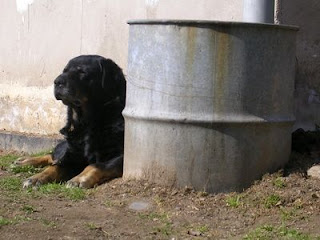
Friday, July 13, 2012

What You Must Know If You Want To Adopt A Stray Dog

Every day people see stray dogs on the streets, wandering neighborhoods, and going from door to door begging for food. Fortunately, there are good hearted people who select to adopt them, bring them into their families, and give them a chance at a good life.

If you're considering adopting a stray dog, you should know that there are both challenges and rewards. Since you'll be bringing the dog into your home and family, it’s foremost to weigh both sides of it before you make a final decision.
One of the major challenges in adopting a homeless dog is not knowing its background. The dog could have been exposed to approximately anything, and you have no way of knowing before you adopt it. This can mean the dog has severe condition problems, and you won't know until you take the dog to the vet for an exam. Make sure you take the dog to the vet's office right away, and continue regular check ups to keep it healthy.


Another big challenge is his or her behavior. After living on the streets, many dogs revert back to wilder behavior, doing anyone they can to survive. This means they may be wary of humans, defensive, and not know “proper” behavior in a family setting. When you adopt a stray dog, you have to work to be extra diplomatic with it as you teach it how to socialize with humans.

Discipline goes along with behavioral problems a stray dog may have. Depending on how long the dog was on its own, it may have no discipline and not know what proper behavior is. While you're gentle, you must also be firm with the dog, and keep up the training, even if it's difficult. If the dog is an adult, it may be even harder to train, but patience, gentleness, and love will help.

Despite the challenges that come with adopting a stray dog, there are great rewards, as well. One of the most foremost is the chance to give a dog a chance at a good life. And, for many dogs, that second chance well means the inequity in the middle of life and death. Saving the life of a stray dog is a pretty big reward!

Another bonus to adopting a stray dog is the love and companionship of the pet. One of the big reasons people adopt dogs is for companionship and love. No matter what a dog’s background, if you continue to love it and are diplomatic with it, the dog will ultimately show you love and affection, as well.

Wednesday, May 2, 2012

People Should Have Fallen In Love With An Indian Stray Dog


Stray Dog
India is home to one of the largest stray animals in the world. And, the most numerous among them are the stray dogs! Looks like it’s is the dog mating season! So many dogs & bitches in the Vashi area have given birth to puppies, the average litter size being 4-5 for each pair.

Compared to the pet dogs who enjoy free meals and good health care, these stray puppies are the victims of their own destiny. Born on the street, they often have no proper food or water and become the carriers of disease by living in unhygienic conditions. Many of them get injured by passing vehicles or lose their lives to starvation & disease. The puppies in this picture live in a gutter in front of my house.

Thanks to a kind man who regularly feeds them with milk, they still look healthier than most other street pups. I also drop some chapatis near the gutter from time to time which both the pups and their mother happily chew on!

Back in India after a year, I am most intrigued by that omnipresent animal, the Great Indian Stray Dog. As I have become older and possibly more mature, I am now able to fully comprehend the greatness of this feisty, versatile, and clever creature that blends so magnificently with the urban landscape of India, with its dug up roads, stinky smoky hot air, noisy streets, and real life abundance of Kathe Kollwitz prints.

It is unlikely that National Geographic will ever have these animals on its cover. The Great Indian Stray Dog usually sleeps during the day and with its ears drooping, its genitals grossly exposed, it may seem like the last animal Paris Hilton would want to kiss. But bear this in mind; the looks of the Great Indian Stray Dog can be deceptive. For when it is excited, its ears raised, its hips high and slender, its legs long and powerful, its strong jaws letting out a piercing bark, the Great Indian Stray Dog has an appearance good enough to qualify for being the symbol of any state or political party. One may argue that these dogs have been a victim of globalization, as is evident from their Jamaica style street culture. But at least these hoodlums have some personality as opposed to the arse licking, kiss seeking, shoe wearing character of the domesticated ones.

And these dogs know it all too well. It looks with disdain as rich fat people drag along with them collared hairy dogs from western lands, their tongues wagging. The Great Indian Stray Dog considers these useless opportunistic sloths in similar vein as popular culture disdains fat balding white men in Bangkok’s streets.

The Great Indian Stray Dog is also the only last animal to still believe that global warming is the biggest hoax of all times. After all, it has been experiencing something more akin to global cooling. That is because as much of the world is being converted to parking lots and more tires are being manufactured than new human legs are taking birth on earth, these dogs have lot more cool shaded areas to relax than ever before.

While animal rights activists have ensured that the urban sprawls are designated as protected reserves for them, not all is going well for the Great Indian Stray Dog. After all, since they are mostly reliant on human trash for food, these dogs are as much afflicted by obesity, high cholesterol and diabetes as we humans are. They are doing their best to cope up with this “Supersize all” culture by trying to be more active. I myself have been chased by them many times during my morning runs. But such tactics can be fatal and one can often see a martyr in the street, its entrails jutting out and offering a feast to the flies, its head mashed by the heavy tires that went over it, and its eyes being poked by a crow, the other great survivor of urbanization.

So next time you see the Great Indian Stray Dog, consider its life for a moment. And if you have some time, ask some stupid scientist to put a radio tag around one to experience firsthand how urban legends are made. Believe me; it would be far more exciting than watching endless repeats of snorting whales or pampered pandas with milk bottles on TV.

As a veterinary nurse I just wanted to put down my thoughts and experiences regarding adopting a street dog and transporting it back to your own country. Specifically countries with high quarentine regulations such as the UK or the USA. I am aware this can be quite a contraversial matter as emotions are very much a part of a decision like this.

Whilst I have met many people whom have fallen in love with an Indian street dog and decided to give it a better life by transporting it back to their own country. I fully emphasise with this situation and agree that it is very hard once you have built up a rapport with a street dog, to then leave it behind unsure of it's future. Believe me I have suffered from this on many an occasion.

However please take note of this: In the UK, as this is the only country in which I know the details of quarantine regulations, it is not possible to transport an animal from India on a pet passport system so an animal brought into the UK would have to spend six months in quarantine kennels once it had reached the UK. Six months kenneling in itself can be highly distressing for an animal, particularly one who is used to spending their life roaming stray in their own natural territory. Another stressful experience for an animal is the shipping itself in the noisy and cold hold of an aircraft although often animals are rightly sedated for this.

The next issue is the cost. Again I am only able to comment on the UK in which it costs around £3000-£4000 at least to kennel one dog in quarantine for six months and additional high costs for the shipping itself. I regularly volunteer and work as a development officer for an animal charity in north India. The charity treats sick/injured animals, mostly street dogs, at it's own small shelter and arranges for vaccination and sterilisation. It reaches and helps around 150 dogs a year. This is albeit a very small charity but is able to carry out all this work with an annual turnover of 90,000 INR so about £1000 if you'll excuse my crude currency convertion.

Thus the money you would spend on making one dog's life better by adopting them and shipping them abroad could potentially keep a small Indian street dog charity running for three years, potentially saving the lives of 450 dogs!!!!

Thursday, April 26, 2012

Take Stray Dogs As "Man’s Best Friend"


stray dog
Dog helped early humans to establish small colonies which eventually turned into early civilizations. Serbians from Bering Strait, Asian tribe like Athabascan and indigenous American tribes like  Apache and Navajo could not have possibly survived without the help of Dogs. Domestication of Dogs has also been recorded in the glowing history of Indus Valley Civilization.

We have studied that dog is a multipurpose animal turned into pet for more than 15000 years or so. Since then man is using dog as a security guard to home, farms and cattle, also as a friend and now even in assisting military and helping physically challenged people.

Hence, Dogs are very well known as “Man’s Best Friend” but perhaps dogs don’t know that humans are also known as “Most Selfish Creature”

Today’s Indian stray dog was once used to live proudly under the shelter of his owner who has suddenly left it abandoned, and made completely dependent on the leftovers thrown away on road side. What else could be a better way to show gratitude for whatever these “once pets” had done for human societies.

But now it’s too much. We certainly cannot take more of their howling and barking, their littering and shitting anywhere, spoiling the beauty of our cities, they can even attack us and they already did it many a times before. They are totally intolerable and annoying. So, the best way of getting rid of them is just stop feeding them till they disappear one day. We don’t care about what dogs did to our great great great grandpa’s great grand pa, why would we care? After all what is the use of uncivilized animals between civilized human society?

Clueless of what I am talking about? Let me confess, I used to believe what I wrote in the paragraph above. You can call me a merciless person but that’s what I always used to think of stray dogs till one day I saw three bulky men with iron rods tied with iron wires catching stray dogs on road. They were hunting these animals and quickly they succeeded in trapping one poor dog. That animal was unusually screaming and bleeding from his mouth, fighting with those lifeless wires and rods, finally he gave up himself to those proud he-mans.

According to the Humane Society, "4 million cats and dogs -- about one every eight seconds -- are put down in U.S. shelters each year." Several factors contribute to the burgeoning population of homeless pets: the economic crisis, the failure of pet owners to spay and neuter their cats and dogs, and lax puppy mill laws. Because shelters have so many animals to feed and protect, they are often unable to handle the volume. Pet lovers across the nation can help shelters and animal welfare organizations handle the crisis.

Consider your skills and availability. Are you a writer? Get involved with the fight for animal rights by drafting a letter or article to your local newspaper urging your fellow citizens to help the cause. Do you have experience in the legal field? The ASPCA urges volunteers with professional legal skills to aid shelters and animal welfare organizations by reviewing and challenging laws. Are you tech savvy? Creating a website for your local shelter will connect homeless pets to potential owners.

Visit your local shelter and volunteer. Depending on the shelter, you can contribute by either donating your time or money. Many shelters look for volunteers to help clean cages, dish out meals or socialize with the animals. Handymen are needed to help build or repair storage areas and cages. If you do not have time to volunteer, you can always donate money or items such as food or blankets.

Organize a fundraiser at your workplace or school. Even if you cannot donate to a shelter or organization, you can make an effort by helping to raise funds. Money collected, even in small amounts, from a group of people can make a big difference.

If you feel comfortable taking in a homeless pet, consider becoming a foster parent. Petfinder.com is a national website dedicated to matching homeless animals with their forever homes. Hundreds of shelters from across the nation advertise on the site, and many are looking for individuals with time, patience and knowledge to temporarily house homeless animals.


Tuesday, April 24, 2012

Take Stray Dogs In Our Homes As Members Of Our Family


Stray Dog
When it comes to pets, many of us love the sight of a furry tail wagging. Most times, that furry tail belongs to a pooch who came from a reputable and conscientious source. The sad truth is, however, that many dogs end up on the street. There are several reasons for the number of stray animals, most of which are usually unpleasant, the result of negligence or irresponsibility or because pet owners - regardless how often they are told - don't grasp that dogs and cats can live as for up to 15 years and beyond.

Still other times, they simply run away and are never recovered and lastly and most troubling (at least to this author) are the ones who are abandoned simply because the dog is 'too big of a burden' or 'not what was expected'. Any way you look at it, the stray dog population is in the millions, spread all over the country. Some caring and enterprising people have taken it upon themselves to lighten the load placed on animal control services and shelters by adopting strays from off the street.

That isn't to say that every adopter is a prime candidate. Still, give them credit, animals seem to have a sixth sense about this sort of thing. When selecting a shelter from inclement weather and dangerous environs, they tend to hole up somewhere that they consider to be safe and potentially lucrative. Even so, if you open your door during a storm and see a sopping wet four-legged visitor, there are a few things you should consider before allowing him or her into your home.

You cannot equate domesticated and dogs of good breed with wild and stray dogs. Stray dogs have only a pack behavior that is inherited and marking of territory but nothing else. Whereas domesticated dogs are trained and live together with humans in our homes as members of our family.

Every dog of good breed needs to undergo sufficient training so that he is able to adjust to living in home with family and adapt to the ways as well as learn to obey rules and behave well.

One look at a well trained and well behaved dog will tell you how happy everybody in the family is and the dog is well looked after too. Because the dog is well behaved, it is well looked after and loved too.

On the other hand the untrained dogs are very wild and unruly. They often get into trouble with their owners due to their misbehavior without knowing why. They end up getting punished most of the times for no fault of theirs, all because they haven't been trained.

The owners love taking their well trained dogs with them and enjoy showing them off. Since they are well trained, they know how to behave and what is expected of them when they go out. They get to be admired by one and all.

A trained dog is able to live comfortably in our homes and manage to get by without getting into any problem. They understand the rules to follow and you can command them verbally and get them out of trouble and keep them safe. For example they know the rules to follow while crossing the road.

A trained dog can be guided on how to cross the road safely by listening to your commands and wait until the cars pass and then cross when it is safer to cross.

Wednesday, April 18, 2012

Train Your Dog How To Go To A Toilet

dog pees
Most dog owners would love to have a well-trained dog, yet many dogs are not trained very well! You should understand that it is very possible to train your dog. Especially for those dogs pee everywhere.

However one thing may troubles you that is your puppy is simply pee anywhere and not pee in toilet.The sooner you start toilet training puppies the earlier your little dog will surely stop making any mess in the home.you might be worried that training your dog is too difficult or time-consuming, then please understand that, like many things in life, it's only difficult until you learn how to do it right.

Remember that puppies need to go pee an awful lot when they are young.Be certain to take your puppy outside after waking,eating,playing and any other activity that gets it excited.Toilet training puppy will be made way easier once you realize that just about its behavior.Train the puppy go to toilet and always lead puppy to the toilet.The Puppy will quickly realize this is the behaviour expected from it.Puppy react very well to bless.It shouldn't be disparaged as an effective coaching tool.If a puppy feels it has done something that meets with your approval it will be sure to try and repeat the action.For puppy potty grass,do not forget that consistency is important.By repeating the above steps housetraining your puppy will be accomplished much quicker.Don't forget to always stay calm,getting angry with a puppy that has gone to the can in the house will get you nowhere.Don't scream and get mad,understand that this is a part of having a young puppy.Never give up,stick with the Puppy potty coaching and you will be shocked how speedily your puppy will make a response to your work.All puppies need to be shown what is the correct way for them to behave.They learn what pleases you and will attempt to repeat the favorable behavior when they can.

As difficult as it might be, you have to stop saying anything to your dog before you leave. Be quiet, don't speak and do not pet your dog, just leave. Do the same when you get home. Walk in, check your mail, change clothes, whatever it is that you do and then after a while you can start talking to your dog. You are trying to establish that your being away was not a big deal, which leaves no reason for your dog to bark. Keep in mind, that consistency is the key factor to successful training dog pee.